
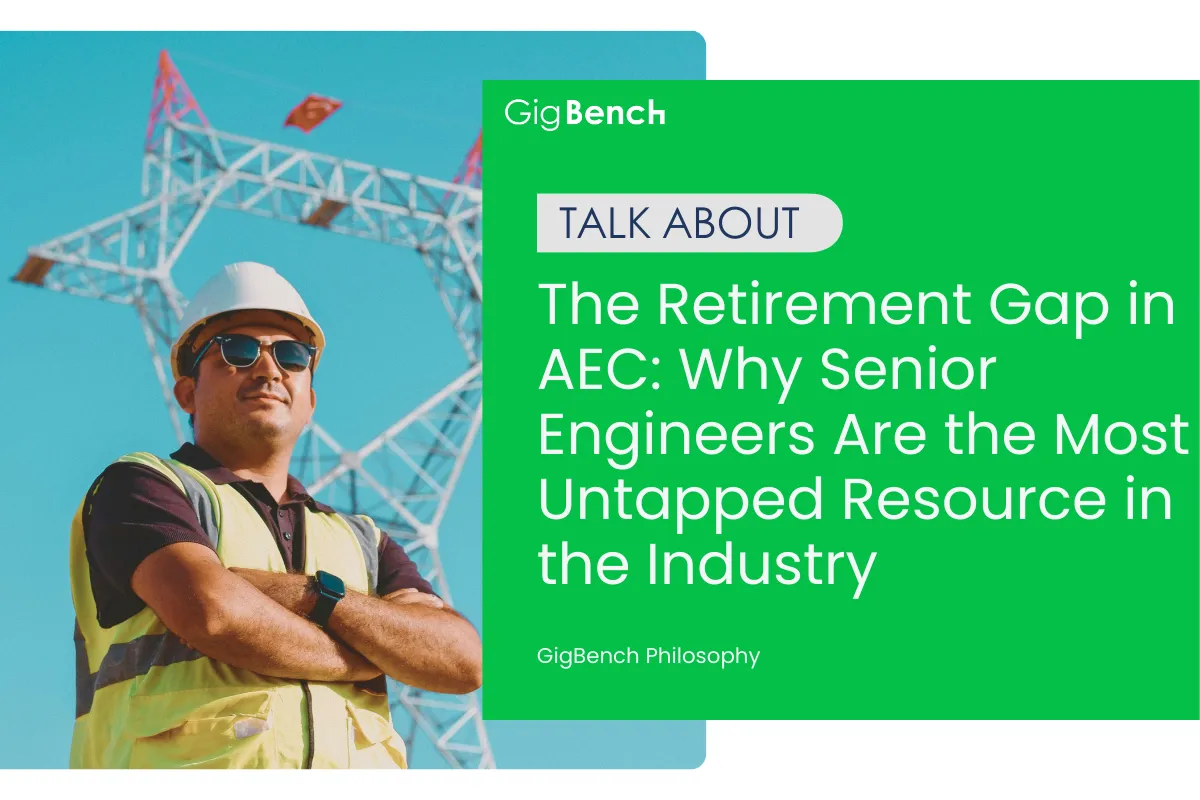
The Retirement Gap in AEC: Why Senior Engineers Are the Most Untapped Resource in the Industry
The AEC industry is in the middle of a generational transition that has been building for years and is now accelerating. Baby boomers who have spent three and four decades in engineering and architecture are leaving full-time practice. Behind them, the talent pipeline is thinner than it should be — a direct consequence of the industry contractions that followed the 2008 financial crisis, when a significant portion of the next generation left the field and never returned.
The result is a gap. Mentorship chains that would normally pass institutional knowledge down through the ranks have been interrupted, right as firms need that knowledge most.
What hasn't been fully reckoned with yet is that much of that knowledge doesn't have to disappear. The professionals who carry it are often not finished contributing. They're simply finished with the full-time office model.
A Senior Professional's Perspective on What Comes Next
I spoke to a firm leader at one of the most respected multidisciplinary engineering and architecture consulting firms in the country. With more than three decades of industry experience and a reputation as a recognized expert in his field, he represents exactly the kind of professional the AEC industry can't afford to lose — and often does.
He's already planning his transition. His target is to be done with full-time practice by 60. But being done with full-time work doesn't mean being done working.
That framing is more common than the industry acknowledges. For many experienced professionals, retirement isn't a clean exit — it's a recalibration. In his case, health insurance for an individual outside employer-sponsored coverage runs roughly $800 to $900 a month, a figure that on its own creates a real financial incentive to keep some professional engagement alive after stepping back from full-time practice.
Can a Retired Engineer Work as a Freelance Consultant?
Yes — and for many senior AEC professionals, freelance consulting is the most practical way to stay professionally engaged after leaving full-time employment. It lets them:
Control the volume and type of work they take on
Work remotely or on a project-by-project basis
Generate supplemental income without returning to a full-time role
Maintain professional relevance and industry connection
Contribute their expertise to firms that could never afford them as full-time employees
The barriers that have historically made this difficult — finding credible project opportunities, managing payments, establishing trust with new clients — are exactly what a professional AEC freelance platform is designed to remove.
The Generational Gap and Why It Makes Senior Professionals Valuable
The specialist pointed to something many AEC firm leaders are increasingly recognizing: the professionals who were in their 30s and 40s during the 2008–2010 downturn are now the ones who should be occupying senior and executive roles. Many of them left the industry during those years and never came back, leaving a structural gap in the talent pipeline that's never been fully repaired.
The consequence shows up at firms of every size: mid-level professionals are being elevated into leadership and client-facing roles faster than the mentorship pipeline behind them can support, without the depth of side-by-side project experience those roles traditionally required. The institutional knowledge that would have been passed down over years of working alongside senior engineers on complex, long-duration projects was interrupted.
This is why experienced professionals represent something more than supplemental labor. They carry 35 to 40 years of applied expertise at a moment when the industry has a genuine shortage of it. For smaller firms that could never justify a senior principal on payroll, access to that expertise on an hourly or project basis isn't a convenience. It's a competitive advantage.
The Confidentiality Barrier That Platforms Must Address
The specialist also raised a concern that likely suppresses freelance interest across the industry: the conflict-of-interest problem for actively employed professionals.
Many senior AEC professionals who might be interested in freelance consulting — to supplement income, test the waters before retirement, or simply stay engaged in the profession — work for firms that prohibit or discourage outside work. For those individuals, publicly listing themselves on a freelance platform carries professional risk. They don't want their employer to discover they're positioning for outside work before they're ready to have that conversation.
In his view, the solution is a confidentiality toggle — a feature that would keep a freelancer's profile invisible to the broader marketplace until they actively choose to apply for a specific project, visible at that point only to the firm posting it. It's a detail worth taking seriously: it speaks directly to what would get the most experienced, most in-demand segment of the AEC freelance pool to actually sign up.
The retirement gap in AEC is real. So is the opportunity to close it with the senior AEC professionals — engineers, architects, and other veteran specialists — who built their careers over decades and are now looking for a way to keep contributing on their own terms.
Create your GigBench profile to start finding project-based work that fits your terms.
Claude es IA y puede cometer errores. Por favor, verifica nuevamente las respuestas.