

The State of the Gig Economy in AEC | GigBench
The way the architecture, engineering, and construction industry hires talent is changing faster than most firms realize. What once looked like a niche workaround — bringing in a freelance structural engineer for a tight deadline, or contracting out a project manager during a busy season — is now a legitimate, data-backed workforce strategy. And the numbers back it up.
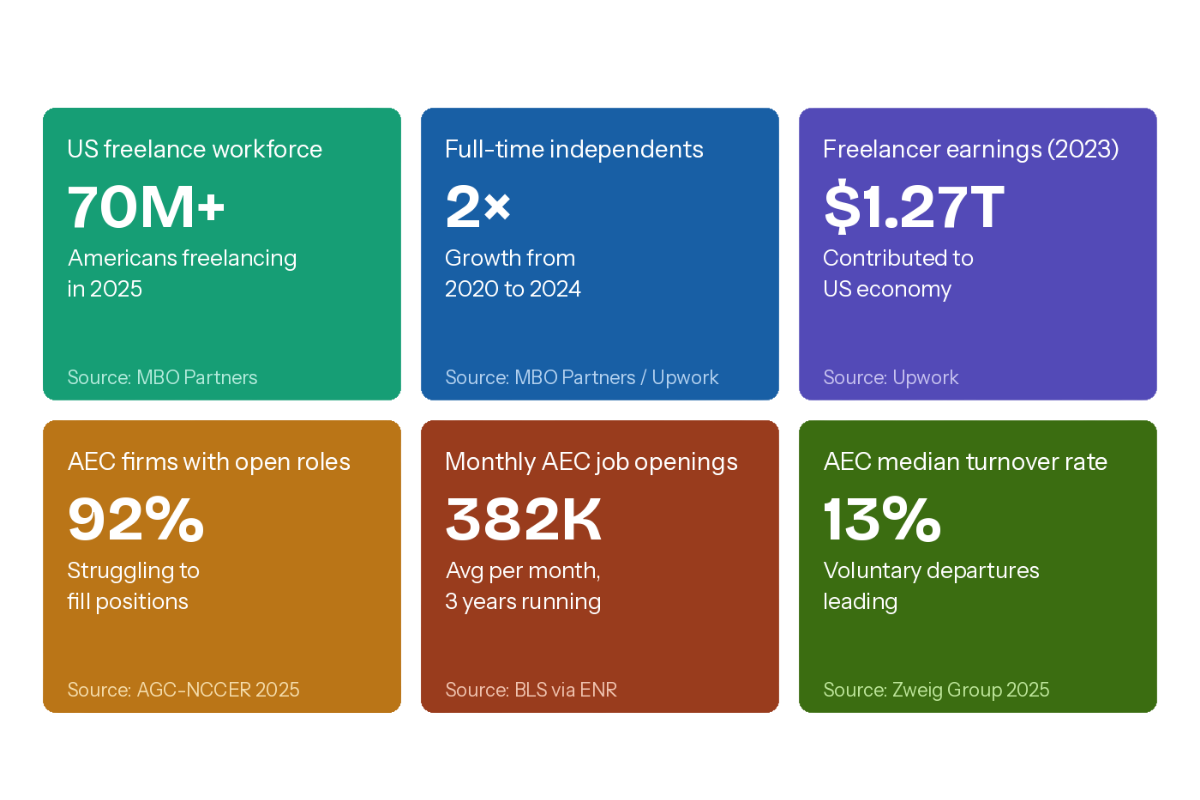
The broader freelance economy has reached a tipping point. Over 70 million Americans now participate in freelance work, representing roughly 36% of the total US workforce. Full-time independent workers more than doubled from 13.6 million in 2020 to 27.7 million in 2024 (Source: The Interview Guys). This isn't a pandemic-era anomaly that reversed itself. It's a structural shift — and AEC is feeling it.
The Macro Trend Is Unmistakably Clear
The global freelance market grew from $8.35 billion in 2025 to $9.91 billion in 2026 at an 18.6% compound annual growth rate, and is projected to reach $20.12 billion by 2030 (Source: DemandSage). What's driving this? A combination of workforce preferences, technology that makes remote collaboration easier, and a growing recognition by employers that specialized talent doesn't have to come with a full-time salary and benefits package attached.
The number of high-earning independent professionals — those making over $100,000 annually — grew from 3 million in 2020 to 4.7 million in 2024. Freelancers collectively contributed $1.27 trillion to the US economy in annual earnings in 2023 (Source: Upwork). The old narrative that freelance work is a fallback for people who can't land a "real job" is gone. Today's independent professionals are choosing this path, and they're thriving.
82% of freelancers reported more job opportunities in 2025 than the year before, compared to 63% of traditional employees (Source: Carry). That gap speaks to something important: the market for skilled independent work is expanding faster than traditional employment. For AEC professionals with deep specialization — think MEP engineers, project controls managers, or licensed civil engineers — this trend creates significant leverage.
AEC Is Not Immune — It's at the Center of It
The construction and engineering sector has historically been slower to adopt flexible workforce models than, say, tech or marketing. The nature of licensed, project-specific work created friction. You needed someone who understood the local code, held the right certifications, and could integrate with a firm's project management systems. That's not a Fiverr job.
But the pressure has become impossible to ignore. The gig economy is set to expand contract and freelance roles in AEC by 20% in 2025, intensifying competition for elite engineers and architects while giving firms more flexible staffing options (Source: AEC Consulting Group). Firms that have been slow to engage with the contract talent market are now finding themselves locked out of the best candidates — because those professionals have already found flexible arrangements that work for them.
According to the 2025 AGC-NCCER Workforce Survey, 92% of construction firms report having a hard time filling open positions, and 45% have had to delay at least one project due to labor shortages — the leading cause of project delays cited by contractors (Source: Associated General Contractors of America). The talent isn't gone. In many cases, it has simply moved. Experienced professionals — including semi-retired architects, engineers transitioning out of full-time roles, and niche specialists who prefer project-based work — are available. They're just not showing up on job boards looking for a W-2.
ENR's coverage of the industry's top professional services firms puts a finer point on this. The US Bureau of Labor Statistics reported an average of 382,000 AEC job openings each month between August 2023 and July 2024 — the third consecutive year averaging close to 400,000 monthly vacancies. Senior leaders at ENR Top 100 firms say the gap between labor supply and demand, coupled with restrictive qualification requirements, has slowed filling available roles and they expect it to continue hovering at these levels as demand grows in manufacturing and data center markets (Source:Engineering News-Record).
What's Driving AEC Professionals Toward Independent Work?
It's worth understanding the "why" behind the shift, because it affects how firms need to engage this talent pool.
Flexibility is the dominant factor. 78% of businesses cite flexibility as their primary reason for hiring freelancers (Source: DemandSage) — but the same logic works in reverse. Professionals value the ability to choose their projects, control their schedule, and leverage specialized expertise without being pigeonholed into a single firm's organizational structure. For senior AEC professionals who have spent decades in the industry, independent work offers something full-time employment rarely does: the ability to do only the work they're best at.
PSMJ's research adds important demographic context here. With Baby Boomers retiring at record rates and a critical shortage of engineers, hiring and retaining top talent has become one of the biggest sustained challenges AEC firm leaders face — one that demographics and demand suggest will continue for years to come (Source: PSMJ). The professionals aging out of full-time roles aren't necessarily leaving the industry. Many are looking for flexible, project-based ways to stay engaged — and they represent some of the deepest reservoirs of specialized knowledge available to AEC firms right now.
Zweig Group's 2025 Recruitment and Retention Report captures the retention side of this picture. The median overall turnover rate across AEC firms sits at around 13%, with voluntary departures outpacing involuntary ones by a wide margin — a signal that employees are leaving for what they see as better opportunities, not because firms are letting them go (Source: Zweig Group). A meaningful portion of that voluntary movement is flowing toward independent and contract work, where experienced professionals have more control over the projects they take on and the clients they work with.
86% of freelancers believe the best days for their industry are still ahead (Source: OysterLink) — and in AEC specifically, that optimism is grounded in real market conditions. Project demand is strong, specialization commands a premium, and platforms built to serve credentialed professionals are emerging to make the independent path more viable than ever.
The Challenge: Trust and Verification
Despite all the momentum, one friction point has slowed AEC's adoption of the freelance model more than any other: how do you verify that an independent professional is who they say they are?
On general freelance platforms, the answer is usually: you don't. You look at reviews, maybe a portfolio, and you take your chances. In AEC, where a single licensing gap or credential oversight can expose a firm to significant legal and liability risk, that's not an acceptable answer. Firms need to know that the engineer they're bringing onto a project is actually licensed in the state where the project is located. They need to know that the project manager they're contracting has the experience they're claiming.
This verification gap is the primary reason AEC has lagged behind other industries in adopting flexible staffing models — not reluctance, not cultural resistance, but the legitimate need for credentialed, trustworthy talent.
Where GigBench Fits In
GigBench was built directly in response to this gap. As a professional marketplace purpose-built for the AEC industry, it connects firms with vetted, credentialed independent professionals — combining the flexibility of a freelance model with the trust and verification standards the industry requires.
The broader gig economy is growing whether AEC firms participate or not. The question is whether those firms will have a structured, reliable way to access that talent — or whether they'll continue losing ground to labor shortages, project delays, and the limitations of traditional hiring.
The shift is already underway. The firms positioning themselves to work with vetted independent professionals now will have a significant advantage as competition for specialized AEC talent continues to intensify.